Introducing Autonomous Threat Research
Our end-to-end agentic research pipeline is generally available: Spectrum continuously researches the threats that can actually reach your environment, and turns that research into detection-ready findings.


Today we’re making Autonomous Threat Research generally available. It’s our end-to-end agentic research pipeline, built for modern environments and AI-speed attacks. With it, Spectrum continuously researches the threats that can actually reach your environment, and turns that research into detection-ready findings.
Threat research: the SOC bottleneck you aren’t focusing on
Threat research today is slow and painful. Before a detection can be written, someone has to work out:
- how the threat shows up in logs
- how the telemetry has to be configured
- whether it applies to your environment at all
- what conditions make it detectable in the first place
That’s days to weeks per threat, spent on manual data wrangling, understanding many different systems, and coordination between people who each hold one piece of the picture. In a world of AI threats and machine-speed attacks, defenders can’t afford to research detections by hand.
How it works
Autonomous Threat Research starts with what Spectrum already knows about your environment: the technologies you run, the infrastructure behind them, and the telemetry they produce. That makes the research targeted instead of generic.
Spectrum monitors new threat activity. When something surfaces, it automatically:
- Finds what the activity targets: the platforms, technologies, and preconditions it depends on
- Matches that against your environment to determine whether it can reach you at all
- Spins up a swarm of agents to scour the web and map the threat: how it works, how it’s observed in logs, how the telemetry has to be configured, and what conditions the defender needs to catch it
- Assesses your detection posture against that map: what you can detect today, and what you need to build for what you can’t
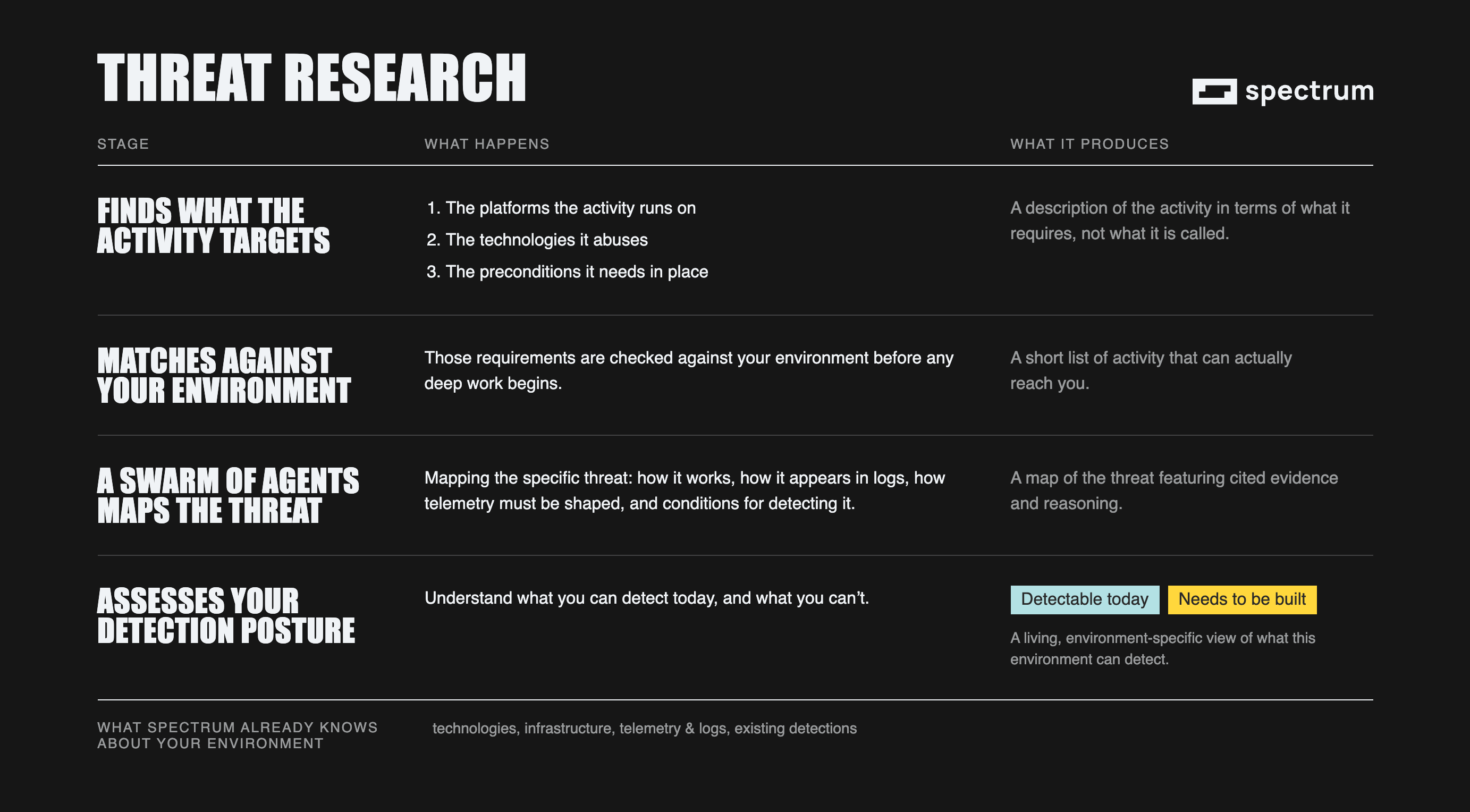
Every finding comes back with cited evidence and the reasoning behind it, so your engineers can check the research instead of taking it on faith. And the research agents are benchmarked every day against graded threat-research tasks, from easy to expert, so research quality is measured continuously rather than assumed.
The result is a living, environment-specific view of the attacker behaviors you should be prepared to detect. With Spectrum, those detections are then built, tested, and maintained for you.
Impact
Early customers have cut the time to research a new threat from four days to thirty minutes.
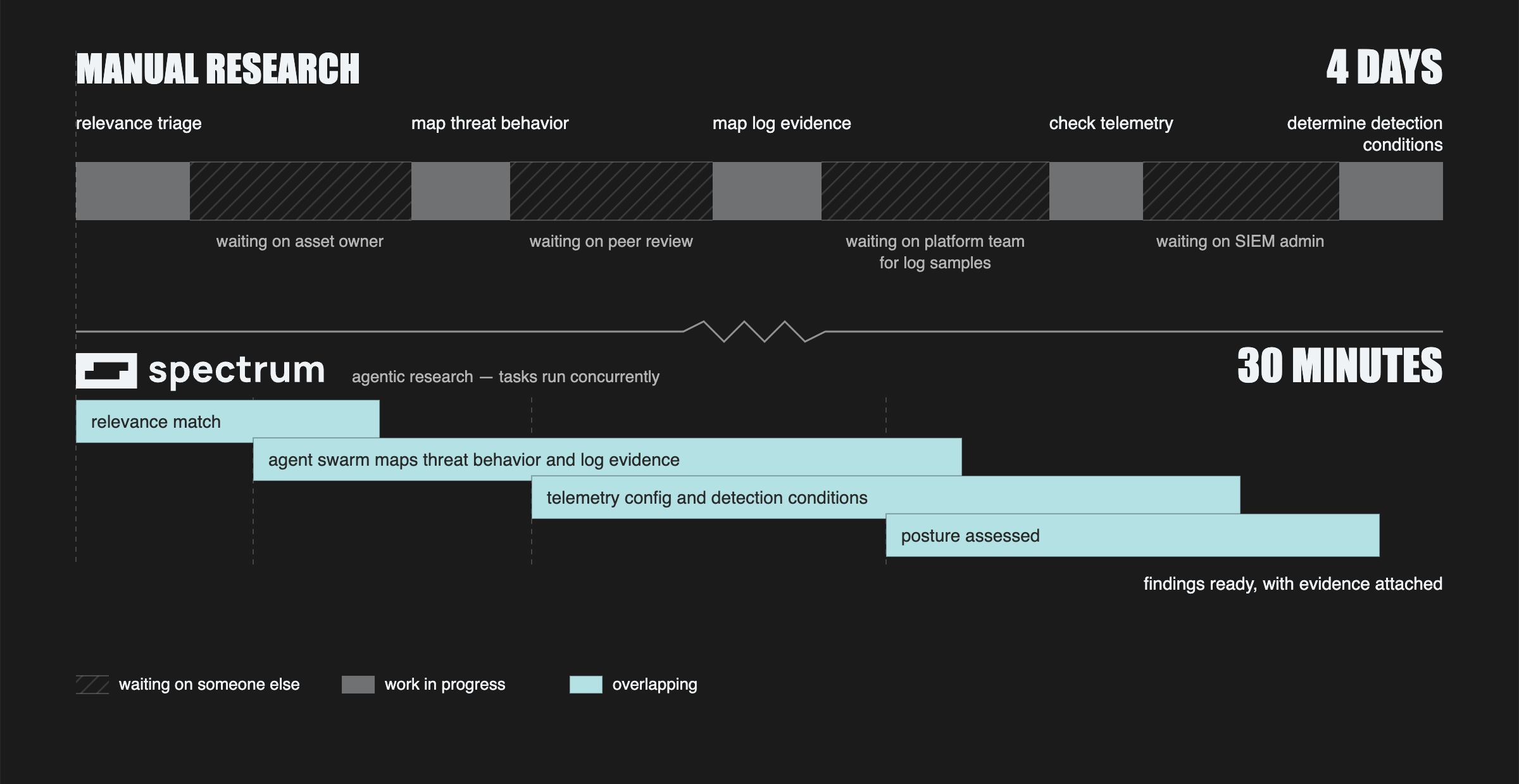
Autonomous Threat Research gives defenders a chance against an ever-increasing volume and speed of attacks driven by AI. With shorter time to research threats, coupled with Spectrum’s detection authoring, SOCs can trust they’re catching and triaging what matters.
Getting started
Want to see which threats actually matter to your environment? Connect Spectrum Security to see what you’re missing.