Save Your SIEM: Why SIEM Replacement Won't Fix What's Wrong
Thinking about SIEM replacement? The bill, the noise, and the gaps usually trace back to one thing: nothing ties your SIEM data to the coverage you need. That follows you to the next platform.


Most teams start looking at SIEM replacement for three reasons: the bill keeps growing, the alerts are mostly noise, and they aren't confident it is contributing towards catching real threats.
All three usually trace back to one thing that has nothing to do with the platform: nothing connects what you pay to ingest with what you need your security program to catch. With no link between data and coverage, nobody audits what's in the SIEM. Everything goes in, every new threat adds more logs, and when the bill gets too big, a new SIEM looks like the only way out.
In a typical SIEM migration, that disconnect moves with you. Fix it first, in the SIEM you already run, and you can get better coverage for less spend without replacing anything. Then decide whether you still want to switch.
This guide covers why teams consider replacing their SIEM, what a migration actually involves, what "next-gen SIEM" does and doesn't change, how to fix the real problems in place, and when replacement genuinely is the right call.
Why teams consider replacing their SIEM
The frustration is real. In Splunk's 2025 State of Security research, 59% of respondents said they have too many alerts and 55% said they deal with too many false positives. The market has also given everyone a reason to re-evaluate: Cisco bought Splunk, Exabeam merged with LogRhythm, Palo Alto Networks bought IBM's QRadar SaaS business, and Microsoft Sentinel is moving into the Defender portal.
But look at what's actually driving each complaint:
| The complaint | Where it usually comes from | Does a new SIEM fix it? |
|---|---|---|
| "The bill goes up every renewal." | Data ingested out of habit, because nothing says which data your coverage needs | No. |
| "Our analysts drown in alerts." | Noisy rules that aren't tuned to your environment | No. The rules get ported, noise included |
| "We don't know what we'd miss." | Rules that broke silently, and no coverage map against the threats that matter | No. Broken rules port over broken, and translation adds new breakage |
| "Writing detections takes forever." | A manual detection engineering process | Not by itself. The process moves with the team |
| "Our vendor got acquired." | Roadmap and pricing uncertainty | Sometimes. This one is about the platform |
What's actually wrong: your spend isn't tied to your coverage
Two things decide what a SIEM costs and what it catches: the data you send it and the coverage you need from it. In most programs they're managed separately. One team onboards sources and pays for ingest; another is expected to detect the threats that matter. Nothing connects the two, so nobody can say which data is earning its place.
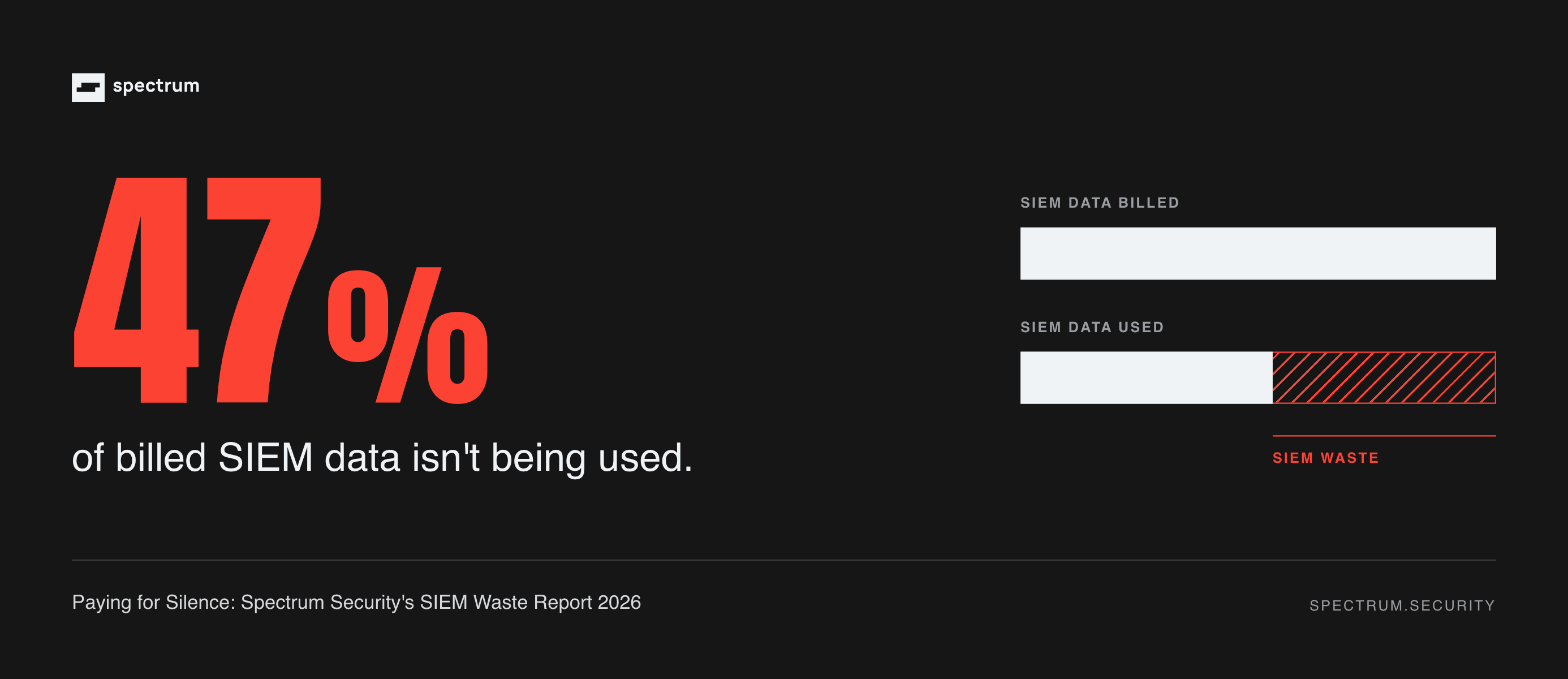
The data: nearly half of what you pay to ingest is read by nothing
In Paying for Silence: SIEM Waste Report 2026, Spectrum's Delta research team traced every log source and field in real production estates across Splunk, Microsoft Sentinel, Google SecOps, and CrowdStrike to the detections, saved searches, and dashboards that use it. The findings:
- 47% waste. Nearly half of billed ingest isn't used, with one estate finding almost 4/5ths of their data was waste.
- Size doesn't save you. Small and very large estates overlapped. The largest paid more than
$8 million a year each to ingest data nothing reads. - Cutting it is low risk. Only 3 in 100 recommended cuts touched a detection rule.
At $2 per GB, that works out to $343,000 in waste for every TB/day of data that you ingest into your SIEM.
The coverage: new threats need new logs, and the bill only grows
Coverage is a moving target. New threats and new services need new logs, and new logs need new detections. If nothing ties data to coverage, the only move is to add: more sources, more ingest, more rules. You can't keep doing that forever. Eventually someone asks for 50% more ingest, and the SIEM becomes "too expensive."
The better question comes first: do we use what we already have? And the coverage you're paying for may not be there at all. Detections that were right when they were written break as schemas shift, sources get renamed, and infrastructure changes. The Detection Debt Report 2026 found 29% of detection rules were broken on average, about 162 in a typical environment.
Independent research points the same way. CardinalOps' 2025 study of production SIEMs found they already ingest enough telemetry to detect over 90% of MITRE ATT&CK techniques, yet detect only a fraction of them, and attributed the gap to manual, error-prone detection engineering. A fwd:cloudsec 2026 audit of more than 2,000 public cloud detection rules found roughly one in three had significant defects.
When the data is there and the detections still miss, the platform isn't the bottleneck.
The alerts: the SOC inherits the noise
Downstream, your analysts pay for it. In Spectrum's alert-noise work with customers, 77% of alerts should never have fired. That's a symptom of the same disconnect: detections nobody tuned, running on data nobody chose.
What a SIEM migration actually involves
A SIEM migration has four big workstreams, and the SIEM vendors' own guides are candid about how hard they are.
| Workstream | What it means | What the vendors say |
|---|---|---|
| Data onboarding | Rebuild collection, parsing, and schema mapping for every source | "Data onboarding can take months" (Palo Alto Networks) |
| Detection translation | Rewrite every rule in a new query language and data model | SPL is piped; YARA-L is section-based, so rules don't port line for line (Google) |
| Content parity | Prove the new SIEM catches what the old one did | Microsoft's migration tool matches your rules to built-in detections, but you review, connect data for, and enable each one (Microsoft) |
| Parallel running | Pay for and operate both platforms until cutover | Two licenses, two sets of pipelines, one team |
Put together, migrations often stretch 6 to 12 months or more, by vendors' own estimates, because teams rebuild ingestion, parsing, schema mapping, and validation for each platform (DataBahn, summarized by nhimg.org). Migrating correlation rules and playbooks "can be brutal," in Palo Alto Networks' words.
Why switching moves the problem instead of fixing it
Here's what happens to the two real problems during a migration:
- The waste comes with you. If nobody has mapped which data your detections actually need, the default is to onboard everything you collect today. You pay for the same unread data on a new invoice, and a cheaper price per GB doesn't change how many GBs you send.
- Broken rules port over broken. A rule that stopped firing because a field was renamed still points at the wrong field after translation. Nobody notices, because it was already silent.
- Noisy rules port over noisy. Your analysts get the same false positives in a new console.
- Translation adds fresh breakage. Every rule rewritten into a new query language and schema is a new chance for a logic error, and Elastic warns that "attempting to blindly copy use cases from one SIEM to another may cause frustration."
- Coverage stays unknown. If you couldn't say what your old SIEM would catch, you can't prove the new one catches the same, let alone more.
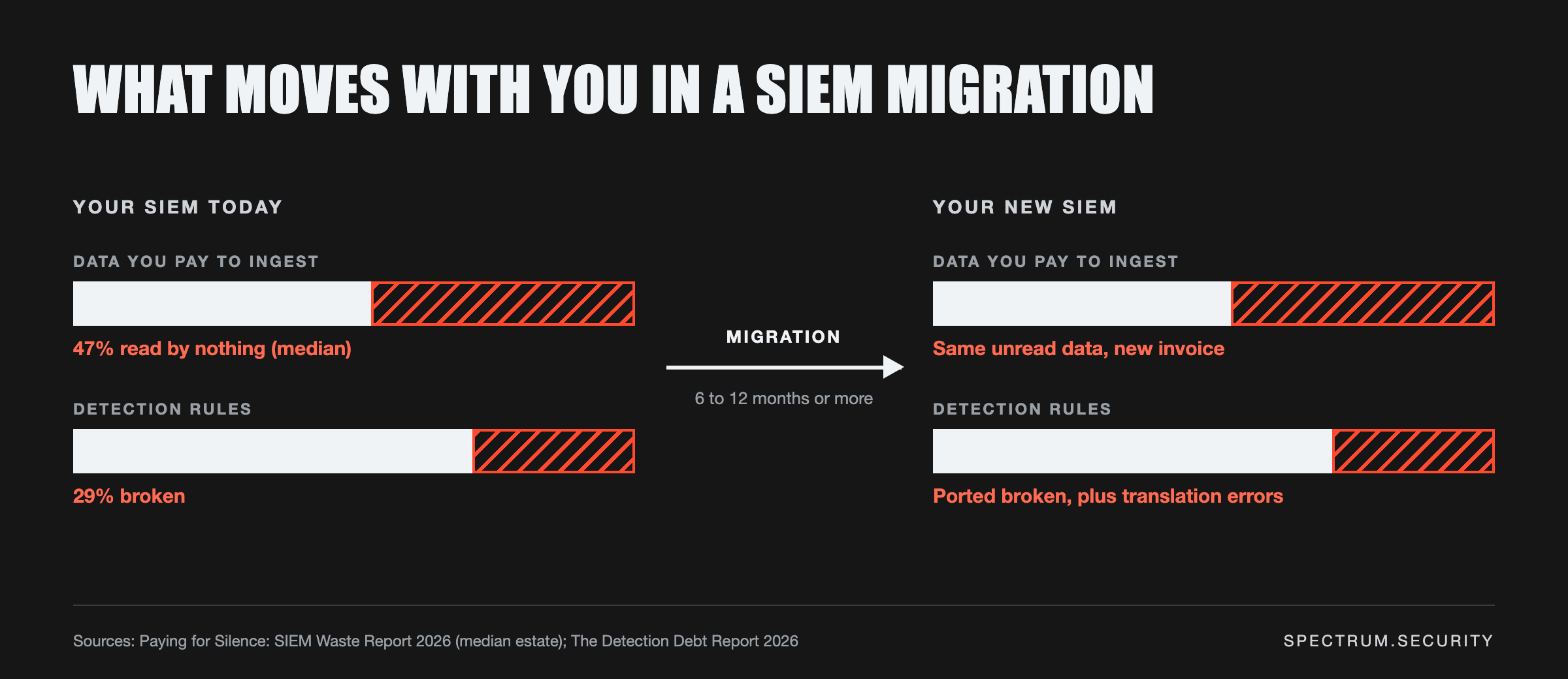
So the most expensive version of a SIEM migration is the common one: 6 to 12 months of effort to land with the same data waste and the same detection debt on a new platform.
What is a next-gen SIEM, and does it change the math?
"Next-gen SIEM" (or next-generation SIEM) is a vendor term, not an analyst category. It usually describes a SIEM that is:
- Cloud-native, with elastic storage and compute instead of on-premises hardware
- Built around a data pipeline, with tiered or federated storage
- AI-assisted, with UEBA, automated correlation, or AI-driven triage
- Bundled with SOAR and XDR, so detection and response share one console
These are real improvements, especially in storage economics and analyst experience. What a next-gen SIEM can't do is decide which of your data matters or know whether your rules still fire in your environment. It runs on whatever you feed it and whatever rules you write for it. Tiered storage still needs something to decide which data goes in which tier. Better tooling on top of the same data and rules gets you faster access to the same gaps.
How to save your SIEM: fix it in place
Saving your SIEM means connecting what you pay for to what you need it to catch, in the SIEM you already run. Five steps:
- Define the coverage you need. Map coverage across your assets, telemetry, and the threats targeting your industry. That's the yardstick every byte of ingest gets measured against.
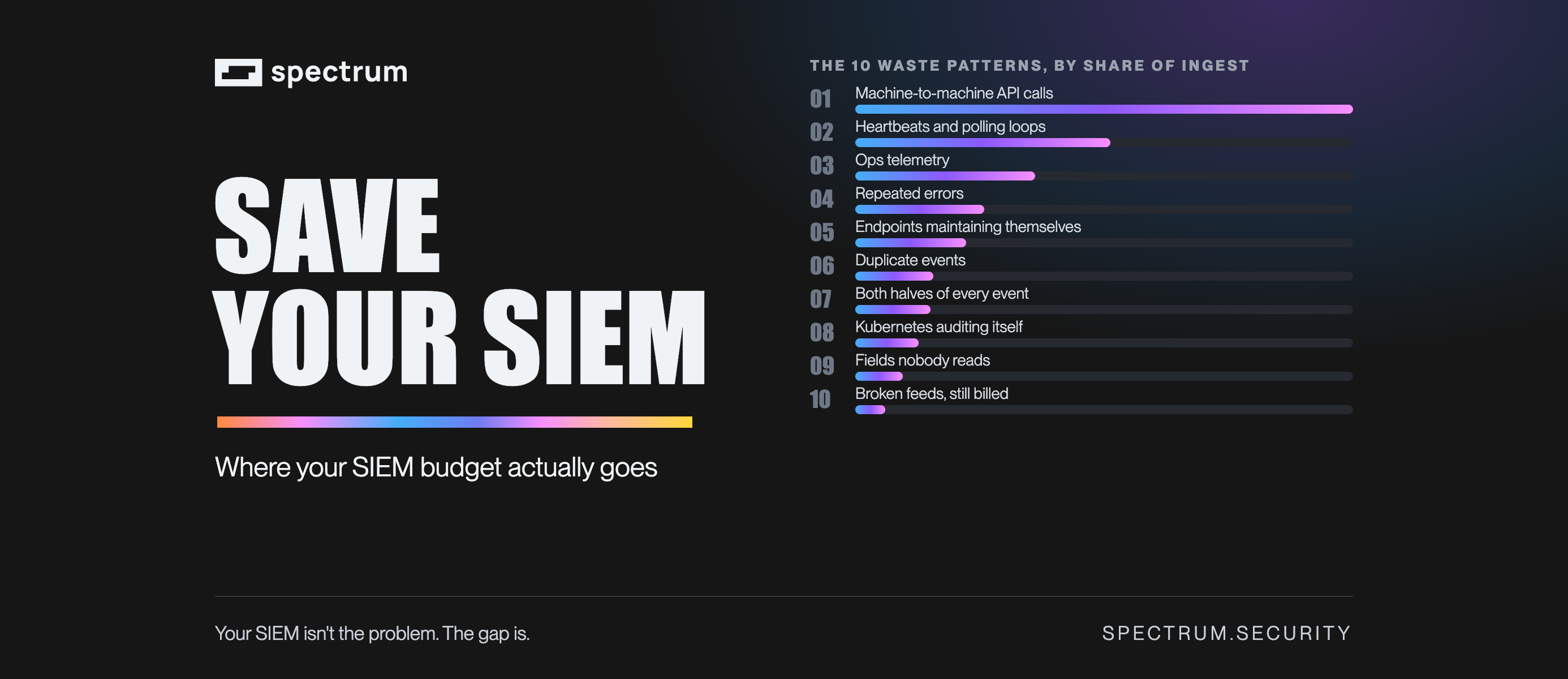
- Tie every source to that coverage. Trace every log source and field to the detections, investigations, and dashboards that read it. Keep the data your SecOps uses in the SIEM, tier the rest to cold storage, and stop collecting what nothing needs. Start with the top five items, which in our data made up more than half of the waste in all but one estate.
- Check that the coverage is real. Verify each detection can still fire: the fields exist, the source is flowing, the logic matches today's schema. Fix or retire what's broken.
- Fund new coverage from what you cut. When a new threat needs new data, pay for it with the spend nothing was using, instead of a bigger bill.
- Cut noise at the source. Tune noisy detections where they live instead of filtering their alerts downstream, and keep checking all of it as your environment changes.
This is the work Spectrum does. Spectrum is the brain of your SecOps: it ties what you pay to ingest to the coverage you need, so you get better coverage for less spend. It keeps the data your SecOps uses in the SIEM and tiers the rest, checking every cut against coverage first, and it builds and tunes detections autonomously, so new threats are covered and the alerts that reach your team are worth acting on.
Spectrum connects to the SIEM and pipeline you already run (Splunk, Microsoft Sentinel, Google SecOps, Elastic, CrowdStrike, Cribl, Bindplane, and more) and writes to them, so there's nothing to rip and replace and no migration risk. One customer went from 52% to 95% detection health, with breakages caught in under an hour.
Saving your SIEM might seem cumbersome, whether you use Spectrum or not. However, it is likely a far easier task than a risky SIEM migration.
When SIEM replacement does make sense
Switching isn't always wrong. Replacement can be the right call when:
- The platform can't do what you need, such as a required deployment model, data residency, or scale it can't reach.
- Your vendor's roadmap or support has changed in a way you can't live with after an acquisition or end-of-life notice.
- You're consolidating onto a platform your organization has already standardized on.
- The economics still don't work after you've removed the waste and fixed the rules.
If you do move, migrate the outcome, not the debt. Fix the data and the detections before cutover, rebuild rules natively for the new platform instead of translating them line for line, and prove coverage parity before you switch the old SIEM off.
Renew, fix, or replace? A decision checklist
| Question | If the answer is... | It points to... |
|---|---|---|
| Do you know how much of your ingest no detection reads? | No | Fix first. You can't compare platforms without it |
| Can you say what share of your rules can still fire? | No | Fix first. Otherwise you'll port broken rules |
| Would your bill be acceptable with the waste removed? | Yes | Renew, and negotiate with the data |
| Is the reason to switch a missing platform capability? | Yes | Replace, and migrate the outcome, not the debt |
| Has your vendor changed course in a way you can't accept? | Yes | Replace, after fixing the data and rules |
| Is a migration being pitched mainly to cut cost? | Yes | Fix first. Most of the cost is in the data, which follows you |
FAQ
How long does a SIEM migration take?
Typically 6 to 12 months or more, by vendors' own estimates. Data onboarding and detection translation take the longest, and you pay for both platforms while they run in parallel.
What is replacing the SIEM?
Mostly, newer SIEMs. Data pipelines, data lakes, and XDR platforms have changed how SIEMs store and process data, but most organizations still need a central place to run detections across many sources. The detections and the data still decide whether it works.
Is the SIEM dead?
No. The category keeps evolving, with cloud-native architectures, tiered storage, and AI features, but analysts and vendors still treat it as core security infrastructure. What's outdated is running it on data nobody reads and rules nobody checks.
Will XDR replace SIEM?
XDR overlaps with SIEM for endpoint, identity, and cloud telemetry, and many vendors now bundle the two. Organizations with broad log sources and custom detections usually still need SIEM-style detection across everything. Either way, the same data and rule hygiene applies.
How much can you save without switching SIEMs?
It depends on your ingest and your contract. In the SIEM Waste Report, the median estate was paying for 47% of ingest that nothing read. At $2 per GB, that's about $343,000 a year for every TB a day you ingest. You can estimate your own number with our ROI calculator.
The takeaway
Your SIEM isn't the problem. The bill, the noise, and the blind spots come from one disconnect: nothing ties what you pay to ingest to what you need to catch. A migration carries that disconnect to the next platform. Fix it in place first. You'll get better coverage for less spend, and if you still decide to switch, you'll migrate a healthy detection program instead of your debt.
Before you renew or replace, get a SIEM Second Opinion. Tell us about your SIEM, and we'll walk you through where your spend and your coverage are out of step, and what to fix first.