SIEM Waste Report 2026
Paying for Silence
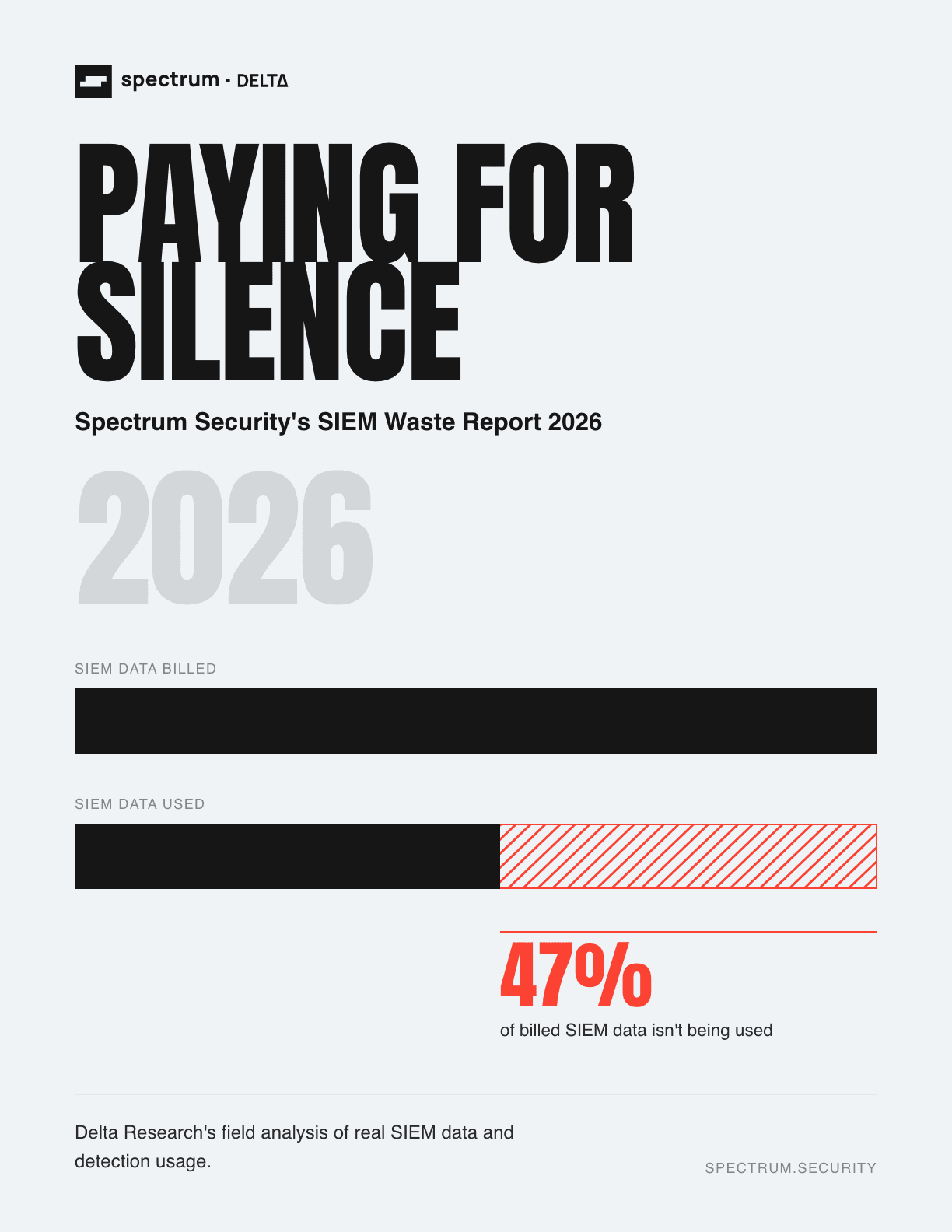
47% of billed SIEM data isn't being used. We measured live customer SIEMs, checking every event class against every enabled detection, saved search and dashboard, to find out which data is actually read and what the rest costs.
Get the report
Inside the report
- What unused SIEM data costs at your ingest volume: $343K a year for every terabyte a day, at a conservative $2 per GB.
- Waste by SIEM product and estate size, across CrowdStrike, Microsoft Sentinel, Google SecOps and Splunk.
- The ten waste patterns that recurred across unrelated organizations, ranked by what they cost.
- Short stories of waste, including the script that cost $3.3M a year.
- Why cutting waste rarely breaks detection: about 3 in 100 cuts touched a rule.
- Five steps to get the money back, starting Monday.
Key findings
47%
of billed SIEM ingest was read by nothing in the median environment: no enabled detection, saved search or dashboard used it, and it carried no investigative value the environment did not already hold elsewhere. #
$343K
a year in unread data for every terabyte a day of ingest, at a conservative $2 per GB, license only. Put another way, 47 cents of every ingest dollar buys nothing useful. #
$8M+
a year was paid for data nothing reads by every estate ingesting more than 10 TB a day. The most wasteful estate measured paid $19M a year. #
46–62%
of ingest was wasted by the smallest estates, under 200 GB a day. The largest, above 10 TB a day, wasted 16% to 70%. No SIEM product and no estate size was immune. #
7–31%
of the entire daily bill was the single largest waste item in each estate, and the top five items made up close to half or more of all the waste found. #
16.6%
of daily ingest, on average, was machine-to-machine API calls in cloud audit trails, the largest of ten recurring waste patterns. It reached a third of ingest in the worst estates. #
3 in 100
recommended cuts needed a detection rule repointed first. The rest broke nothing. 69% of fixes live in the shipper or pipeline, 25% at the source, and 5% inside the SIEM. #
50–80%
of enabled rules in Google SecOps estates produced nothing in 30 days. Reconciling ingest against rules surfaces detections that can never fire. #
| SIEM | Waste |
|---|---|
| CrowdStrike | 62–70% |
| Microsoft Sentinel | 79% |
| Google SecOps | 34–48% |
| Splunk | 16–42% |
The median across all estates was 47%. Waste tracked whether teams had reconciled ingest against what the SOC uses, not the SIEM vendor.
| Pattern | Average share of ingest | Cost per year per TB/day |
|---|---|---|
| Machine-to-machine API calls in cloud audit trails | 16.6% | $121K |
| Heartbeats, health probes and polling loops | 8.5% | $62K |
| Ops telemetry that never belonged in a SIEM | 6.0% | $44K |
| Repeated errors nobody fixed | 4.3% | $32K |
| Endpoints maintaining themselves | 3.7% | $27K |
| The same events, ingested twice | 2.6% | $19K |
| Both halves of every event | 2.5% | $18K |
| Kubernetes auditing itself | 2.1% | $15K |
| Fields nobody reads | 1.6% | $11K |
| Broken feeds, still billed | 1.0% | $8K |
Each pattern appeared across unrelated organizations and SIEM products. Costs at $2 per GB ingested.
Method
- Source
- Live production SIEMs, measured by Delta Research between August and September 2026. Nothing was changed in any customer environment.
- SIEM products
- CrowdStrike Falcon Next-Gen SIEM, CrowdStrike Falcon LogScale, Microsoft Sentinel, Google Security Operations and Splunk Enterprise.
- Estate size
- From under 100 GB a day to more than 70 TB a day. Small is under 200 GB a day, Medium up to 1 TB, Large up to 10 TB, XL above 10 TB.
- Waste
- An event class counts only when no enabled detection, saved search or dashboard reads it, and its evidence is held elsewhere or has no investigative use. Every estate was re-measured on a second day or window, so a noisy release day cannot inflate the finding.
- Price
- $2 per GB ingested (about $730 per GB/day per year), applied to every SIEM. That is at or below what most buyers pay after a typical 25% to 40% negotiated discount. License only: retention, pipeline and transport costs and analyst time are excluded, so the figures are low.
Cite this report
Spectrum Security, Delta Research (2026). Paying for Silence: The SIEM Waste Report 2026. https://www.spectrum.security/siem-waste-2026