The SOC Is Only the Tip of the SecOps Spear
CISOs ranked the AI SOC their #1 priority for 2027. One chart over, their own adoption plans point somewhere else: the detections and data underneath it.


In part one, we looked at the speed problem: attacks that used to take about four weeks now take about 18 hours, and that's the #1 worry for security leaders heading into 2027. This post is about what they plan to do about it.
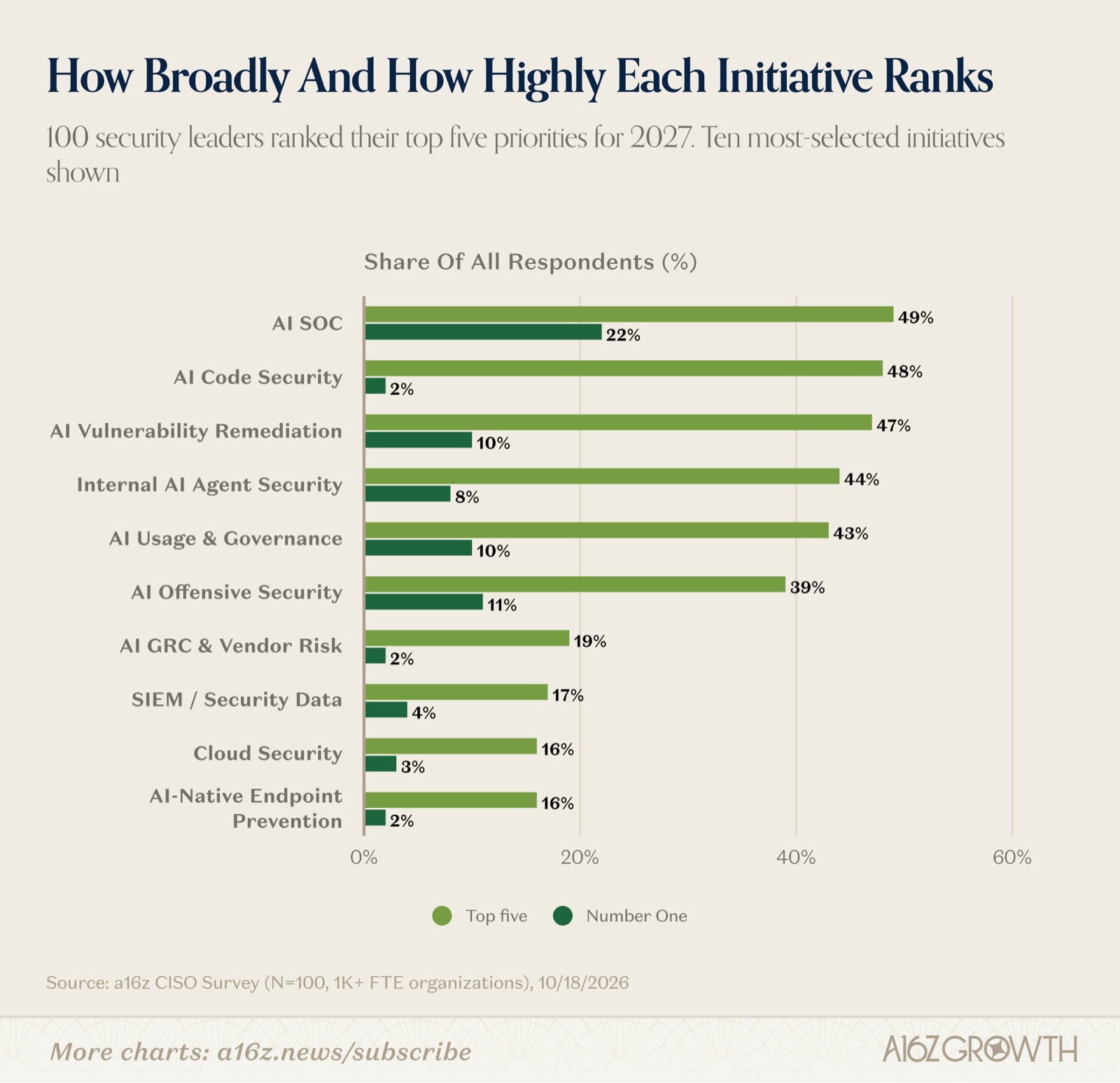
a16z asked 100 CISOs at companies with 1,000+ employees to rank their top five priorities for 2027. The winner wasn't close.
- 49% put the AI SOC in their top five.
- 22% ranked it #1, twice the share of any other initiative.
- That's up 26 points from 2026.
Source: a16z, The New Security Agenda.
Analysts are drowning in alerts, attacks have gotten faster, and an agent that can triage and investigate around the clock sounds like exactly the right answer. An AI SOC can be a real help to a team that's underwater.
But the most interesting part of the report is a line a16z drew between the AI SOC and the work underneath it.
Look one chart over
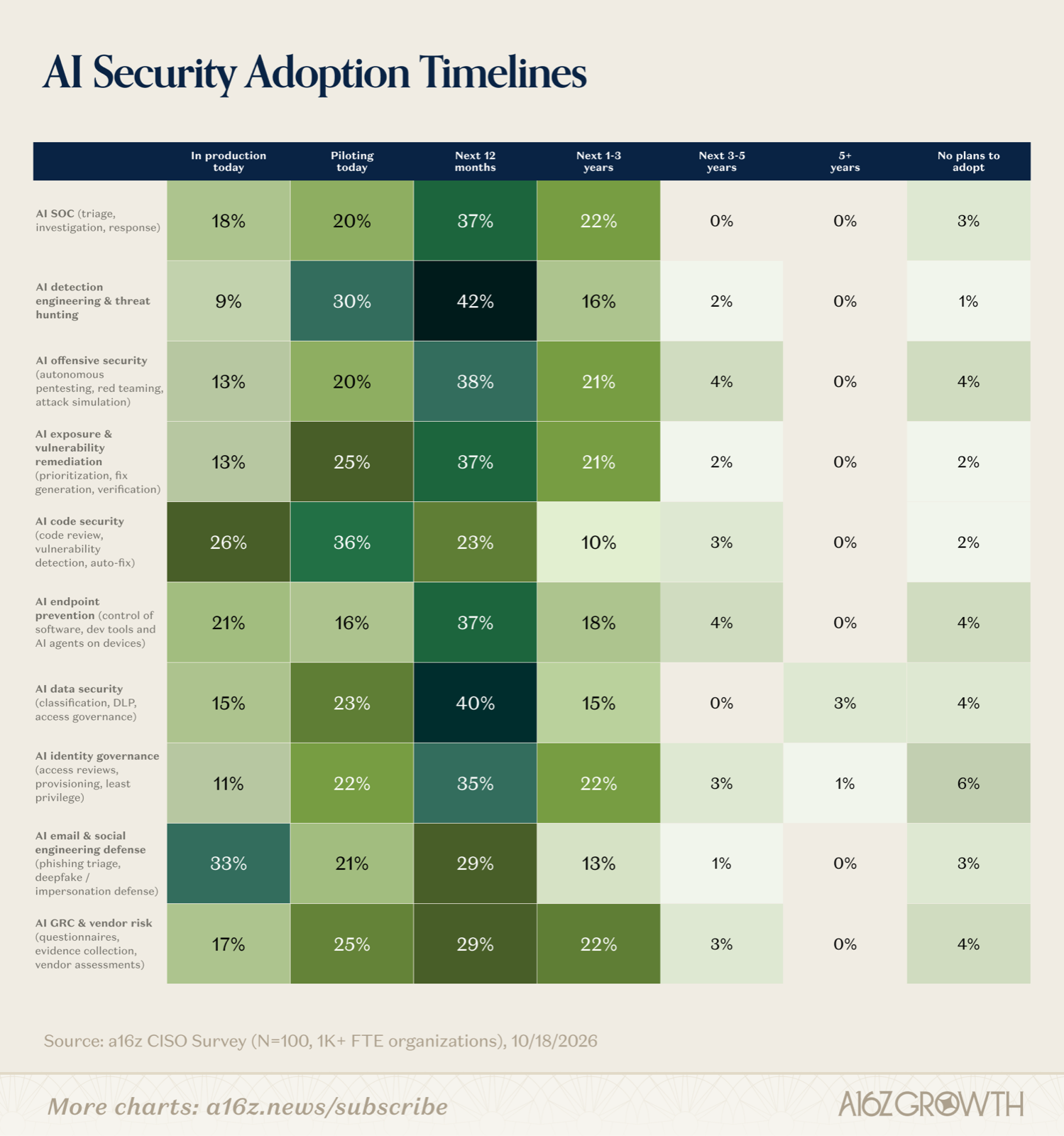
a16z also asked where each AI security category stands today, and when teams plan to adopt it. Two rows caught our eye:
| In production today | Piloting today | Next 12 months | |
|---|---|---|---|
| AI SOC (triage, investigation, response) | 18% | 20% | 37% |
| AI detection engineering & threat hunting | 9% | 30% | 42% |
Source: a16z, The New Security Agenda.
AI detection engineering & threat hunting has the lowest production adoption of all ten categories in the survey, at 9%. It also has the highest share planning to adopt in the next 12 months, at 42%. Add up production, piloting, and next-12-months, and it comes out ahead of the AI SOC: 81% versus 75%.
So the AI SOC is the #1 stated priority, but the fastest-growing category on the adoption plan is detection engineering and threat hunting: the work an AI SOC needs in place to be effective.
At Spectrum, we've seen this before. Our read: when CISOs say "AI SOC," they mean everything upstream that makes the SOC work.
The SOC isn't SecOps
It's easy to use the two words interchangeably, but they aren't the same thing. The SOC is where alerts get worked. SecOps is the whole job of protecting the business, and responding to alerts is only the last step of it.
Doing that job well starts long before the first alert fires:
- Start with threats. Which attacks actually matter to your business, your industry, and the way you operate?
- Map them to your stack. Where would those attacks show up in your environment: identity, endpoints, cloud, SaaS?
- Make sure you have the right data. Are the log sources that would show those attacks collected, parsed, and healthy?
- Build detections from that. Write them for the threats that matter, against the data you actually have, and test them so you know they fire.
- Then respond. This is where the SOC (and an AI SOC) comes in.
If this process sounds new, that's because it wasn't practical before. Before AI, defenders couldn't keep up with every threat. Mapping each one to your data meant working through petabytes of logs and vendor schemas that never stop changing, and a small but mighty security team couldn't do that well.
Today, AI makes threat-driven security possible. Agent swarms, LLMs that never get tired, and AI that's fluent in every detection language mean you finally have the capacity to track every threat and build the detections that matter for your environment, not a generic vendor rule pack or a SOC Prime catalog.
What an AI SOC does with a broken foundation
An AI SOC triages what fires. That's the job. It doesn't know about the detection that broke three months ago when a log source changed its schema.
So what fires in a typical environment? In our research:
- 29% of detection rules are broken (The Detection Debt Report). They look like coverage, but they can't fire.
- In one customer environment, fixing the rules took alert volume from 1,240 to 285. In other words, 77% of the alerts should never have fired.
Put an AI SOC on top of that and you get very fast, very confident triage of noise. You pay twice: once to ingest data nothing reads, and again for an agent to work through alerts that shouldn't exist. Meanwhile, the gaps stay gaps, because a missing detection doesn't show up in anyone's queue.
Sequencing, not opposition
None of this means "don't buy an AI SOC." If your team is drowning, it can help, and the CISOs in this survey aren't wrong to want one.
The question is order. Before you fund the AI SOC, audit what it runs on, starting where SecOps starts. Three things to consider:
- Which threats that matter to your company have no detection at all? These are the attacks an AI SOC will never see, because nothing fires.
- Do we have the data to see them? If the logs aren't collected, parsed, and healthy, even a perfect detection stays silent.
- Which of our detections would actually fire today? A rule that exists isn't the same as a rule that fires against the data you have right now.
If those answers are fuzzy, start with the foundation, not the AI SOC on top of it. The metrics security has tracked so far reflect what teams could realistically manage. Mean time to respond, for example, only starts the clock once an alert fires.
It's time to track two new things: do we have coverage for every threat we know about, and how fast can we build coverage when we learn about a new one?
Based on the adoption plans in this survey, a lot of your peers are already thinking about how to do this.
In part three, we'll get practical: what exactly an AI SOC needs in place before the first alert fires, and a quick self-check to see if yours is ready.
Survey data: a16z CISO Survey (100 CISOs at organizations with 1,000+ employees, fielded 10/18/2026), from "The New Security Agenda" (Oct 28, 2026). Combined adoption figures (81% / 75%) are our sums of a16z's production, piloting, and next-12-months columns. Detection figures: Spectrum, The Detection Debt Report 2026.